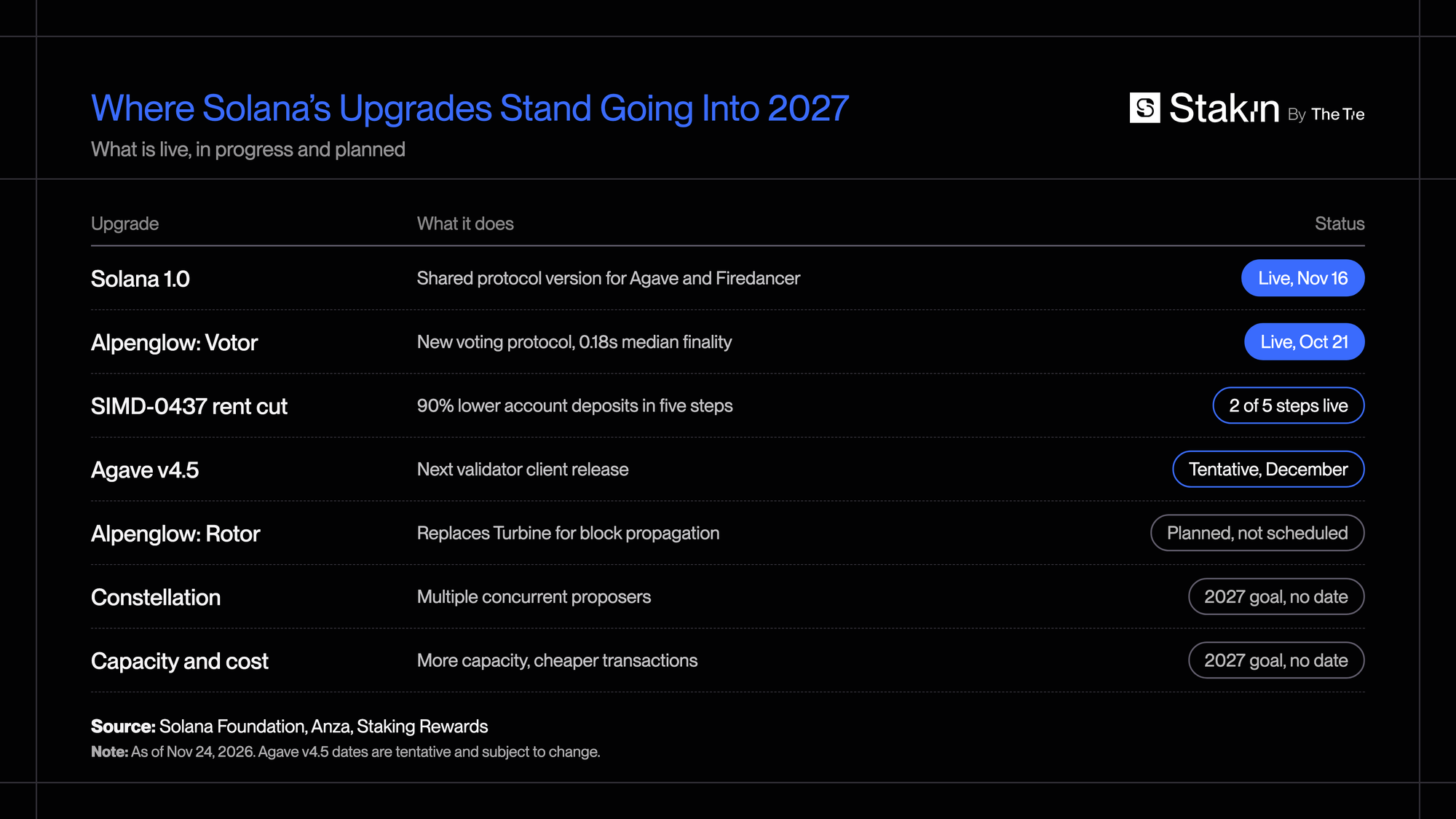
Solana is heading into 2027 as Solana 1.0, with a faster network and a list of what comes next.
Stakin by The Tie runs Solana validators, so we follow these changes from the operator side. Here is where the network stands, what is planned but not yet dated, and what it all means if you stake SOL.
Solana 1.0 and the Upgrade Behind It
On November 16, the Solana Foundation retired the "mainnet beta" label and introduced Solana 1.0. The network itself didn't change.
What 1.0 adds is one protocol version. Solana now runs two independent validator clients, Agave and Firedancer, each with its own release numbers. As Anza put it, "Solana 1.0 is the protocol version, shared across clients."
The Foundation pointed to two milestones behind the move out of beta. Firedancer, a validator client built independently from Agave, has run on mainnet since December 2025. The other is Solana's new consensus protocol.
Alpenglow went live on October 21, and it is the biggest upgrade of the year. At Breakpoint, Anza CEO Brennan Watt noted that it took 18 months to go from white paper to running on mainnet.
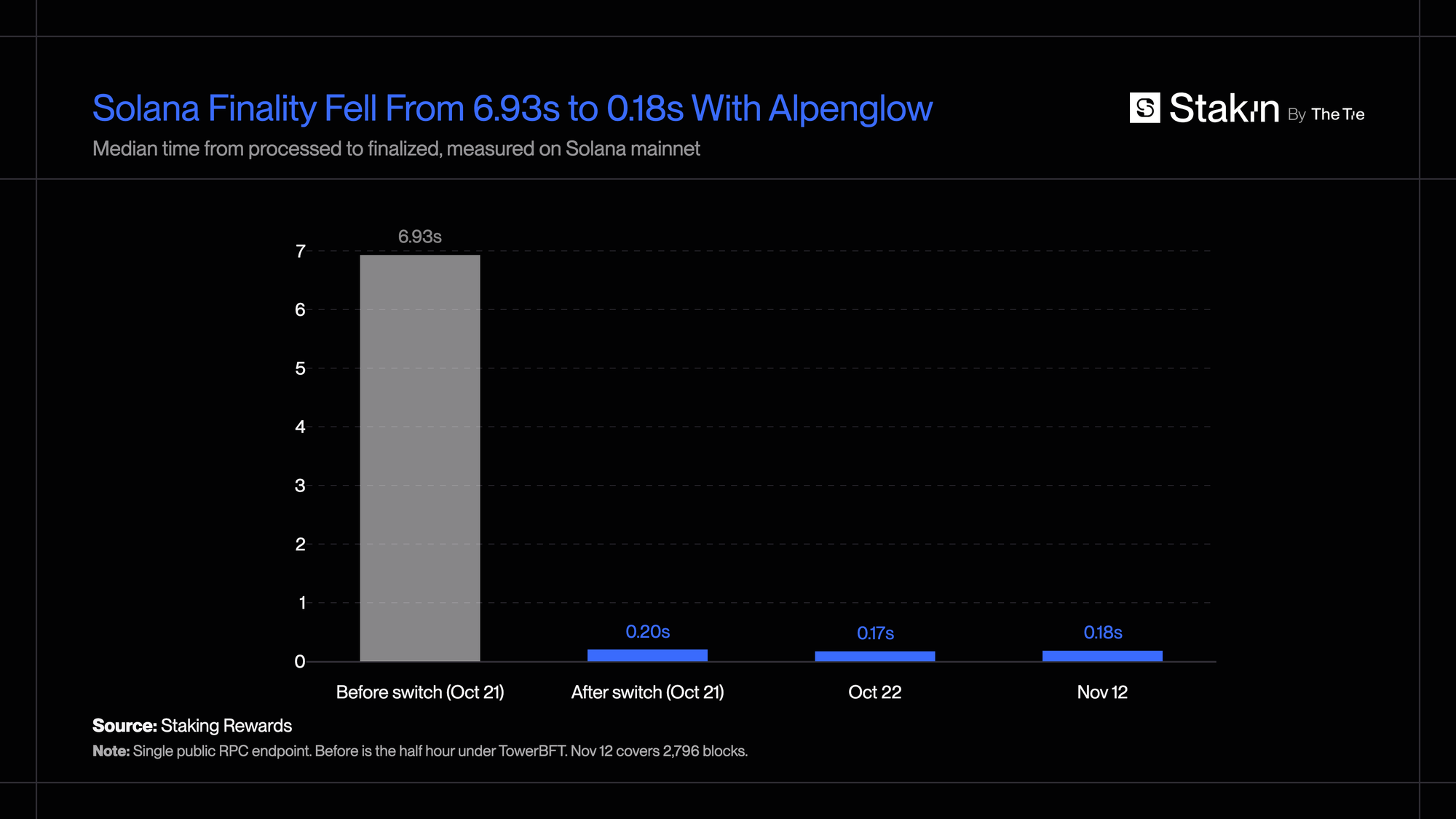
Staking Rewards by The Tie measured the effect on mainnet. In the half hour before the switch, blocks took a median of 6.93 seconds to finalize. On November 12, the median was 0.18 seconds across 2,796 blocks. The starting point is lower than the often-quoted 12.8 seconds because an earlier upgrade had already shortened Solana's slots to about 215 milliseconds.
Alpenglow also changed how validators work. Votes now go directly between validators instead of into blocks. We covered how it works in our Alpenglow guide.
What Anza plans for 2027
At Breakpoint London on November 17, Watt gave the State of the Solana Network talk, a seven-minute look back at 2026 and ahead to 2027. Anza summed up the plans in five posts on X. None of them comes with a date, and Watt said why: "We don't do multi-year road maps. We do releases."
1. A simpler protocol
Watt said Anza will "simplify the protocol, replacing legacy abstractions and interfaces, pushing more of the execution on chain, and modernizing some of the wire formats." He said this makes the network more resilient and lets Anza ship changes faster.
2. More capacity, cheaper transactions
This year, Anza nearly doubled Solana's capacity to 250 million compute units per second. For 2027, Watt said Anza will overhaul the validator's storage back end and rewrite the associated token account program, which creates each wallet's token accounts. It will also optimize how data moves inside the validator. He said the result should be "more capacity, cheaper transactions without disrupting the existing activity on Solana."
3. Faster block sharing (Alpenglow's next phase)
Watt described several extensions to Alpenglow. Leader handoffs will be better pipelined, and the protocol will become geographically aware. Rotor will replace Turbine, the protocol that spreads each new block across validators, with what Watt called "a newer, flatter, faster protocol" that brings network latency down. The Solana Foundation lists Rotor as planned for a later release and not yet scheduled.
4. Validators compete for your transaction (Constellation)
Today, the validator whose turn it is to produce a block decides alone what goes into it and in what order. Watt laid out Constellation in three stages.
First comes a faster market tick, so liquidity providers can better judge how fresh their quotes are. Next comes ordering inside the protocol, which makes it clear to everyone what priority execution takes. Finally, a second proposer joins each block "so that the validators are competing to include your transactions."
For stakers, the economics matter most. In the design Anza published in March, it said Constellation "does not represent a significant departure from existing validator economics."
Validators would still earn base and priority fees in proportion to their stake. That March design differs from the staged version in the talk, so the final fee rules could still change.
5. Heavier computation on chain
Watt said cheaper computation will make "fully onchain options pricing and sophisticated margin models" possible. Transactions will also be able to touch more accounts, so they can reach more liquidity pools and get better execution prices.
Rent is getting cheaper
One change is already rolling out. Every Solana account holds a small refundable deposit called rent, sized to the data it stores. SIMD-0437 cuts the rate behind that deposit by 90% in five separate steps.
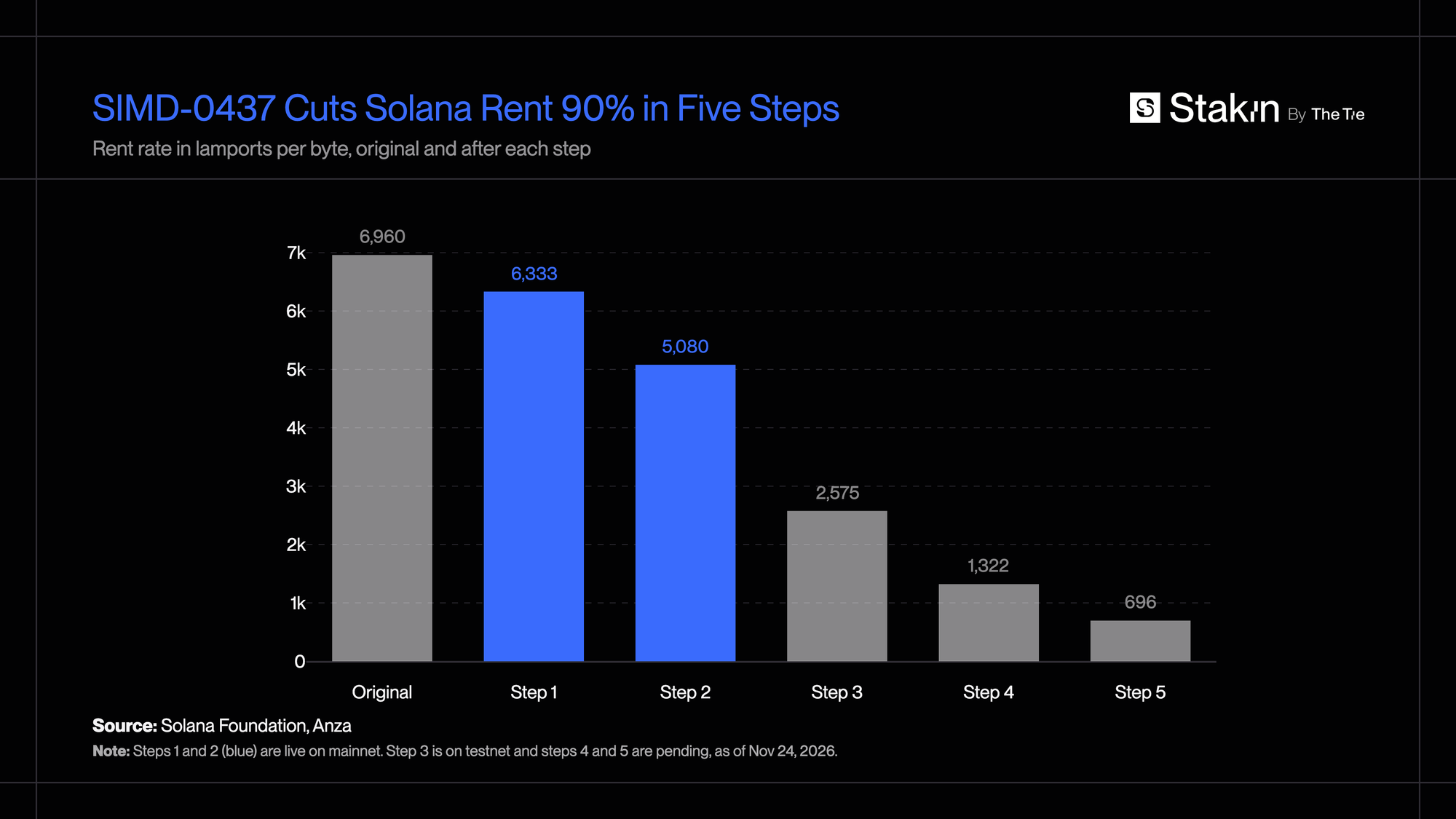
The first two steps went live on mainnet on September 3 and September 11, a 27% cut so far. At Breakpoint, Watt said the rest of the cut, roughly another 7x, would start "in the coming two weeks." As of November 24, step 3 is live on testnet and steps 4 and 5 are not.
Anza has said "there is no fixed schedule between gates" and that each step will activate only after state growth checks out. A separate feature gate can reverse the cut if needed.
What does this mean for you?
If you stake with Stakin by The Tie, you don't need to do anything for Solana 1.0. Your SOL and stake accounts stay where they are, and our team handles client upgrades on our validators as each change rolls out.
Nobody needs you to move, migrate or claim your SOL for any of these changes. Anyone asking you to is running a scam.
For validators
Solana 1.0 changes how operators track upgrades. One protocol version can now be supported by several client releases, so the Foundation advises operators to check which client releases support each protocol rollout.
Alpenglow added a standing cost. Every voting validator pays a Validator Admission Ticket fee of 0.8 SOL per epoch from its vote account. A validator that doesn't pay can't vote or produce blocks in the next epoch.
Anza's 2027 plans reach into the validator itself. Rotor and geographic awareness will change how blocks move between validators, and the storage overhaul will change how each one handles data. Constellation's second proposer would have validators compete to include transactions, and how fees are shared under it is still open.
For institutions and builders
Faster finality means transfers settle sooner, and cheaper rent lowers the cost of onboarding users. The Solana Foundation works through the example of a payments business that opens one million token accounts. Before the cut, that took $159,000 in deposits. Once all five steps are live, it would take $15,900, assuming similar economics.
Looking ahead
Solana enters 2027 with sub-second finality, two independent clients and a clear list of what comes next. At Stakin by The Tie, we'll keep running our validators through each change and sharing what it means for everyone who stakes with us. Thank you for building alongside us this year.
DISCLAIMER: This is not financial advice. Staking and cryptocurrency investment involve a certain degree of risk, and there is always the possibility of loss, including the loss of all staked digital assets. Additionally, delegators are at risk of slashing in case of security or liveness faults on some PoS protocols. We advise you to DYOR before choosing a validator. For further information, please refer to The Tie's Terms of Use.