Alpenglow is Solana’s next major upgrade, and its first phase is scheduled to go live on October 21, 2026. Built by Anza, it changes how validators agree on new blocks so that transactions can be final in about 150 milliseconds.
Stakin runs a Solana validator, so we have watched these changes from the operator side. Here is what Alpenglow changes, what has already moved, and what it means for stakers.
What is Alpenglow?
Every blockchain needs a way for its validators to agree on which transactions happened and in what order. This is called consensus. Alpenglow replaces the system Solana uses today, called TowerBFT.
Alpenglow has two parts.
- Votor changes how validators vote on blocks. It is scheduled to go live on October 21.
- Rotor changes how new blocks are shared across the network. It comes in a later upgrade, and Anza has not set a date.
The aim is a faster and more reliable Solana network.
1. Two ways to finalize a block (Votor)
Votor runs two voting paths at the same time. One finalizes a block in a single round if validators holding 80% of stake vote for it. The other takes two rounds but needs only 60%. Whichever path finishes first counts.
2. Votes move off the blockchain (Votor)
Today, every validator vote is recorded on Solana as a transaction, so votes take up space in each block. With Alpenglow, validators send their votes straight to each other and bundle them into one small proof. That frees up block space for user transactions.
3. No waiting on an offline validator (Votor)
Validators take turns producing blocks. If the validator whose turn it is goes offline, the others now vote to skip its turn and move on instead of waiting.
4. Faster block sharing (Rotor)
When a validator produces a block, it has to send it to every other validator. Today the block is passed along several layers of validators. Rotor is designed to cut this to a single relay step, with each validator passing on a share sized to its stake. Block delivery would then no longer be held back by the upload speed of the one validator that produced it.
5. Built to keep running through failures
Alpenglow is designed to keep the network running even if 20% of stake acts maliciously and another 20% is offline at the same time.
Solana is already getting faster
Alpenglow is not live yet, but a separate upgrade called SIMD-0525 has already sped up block production. Solana produces blocks in short windows called slots. Between August 21 and October 9, SIMD-0525 cut the target length of each slot from 400 ms to 200 ms in four 50 ms steps.
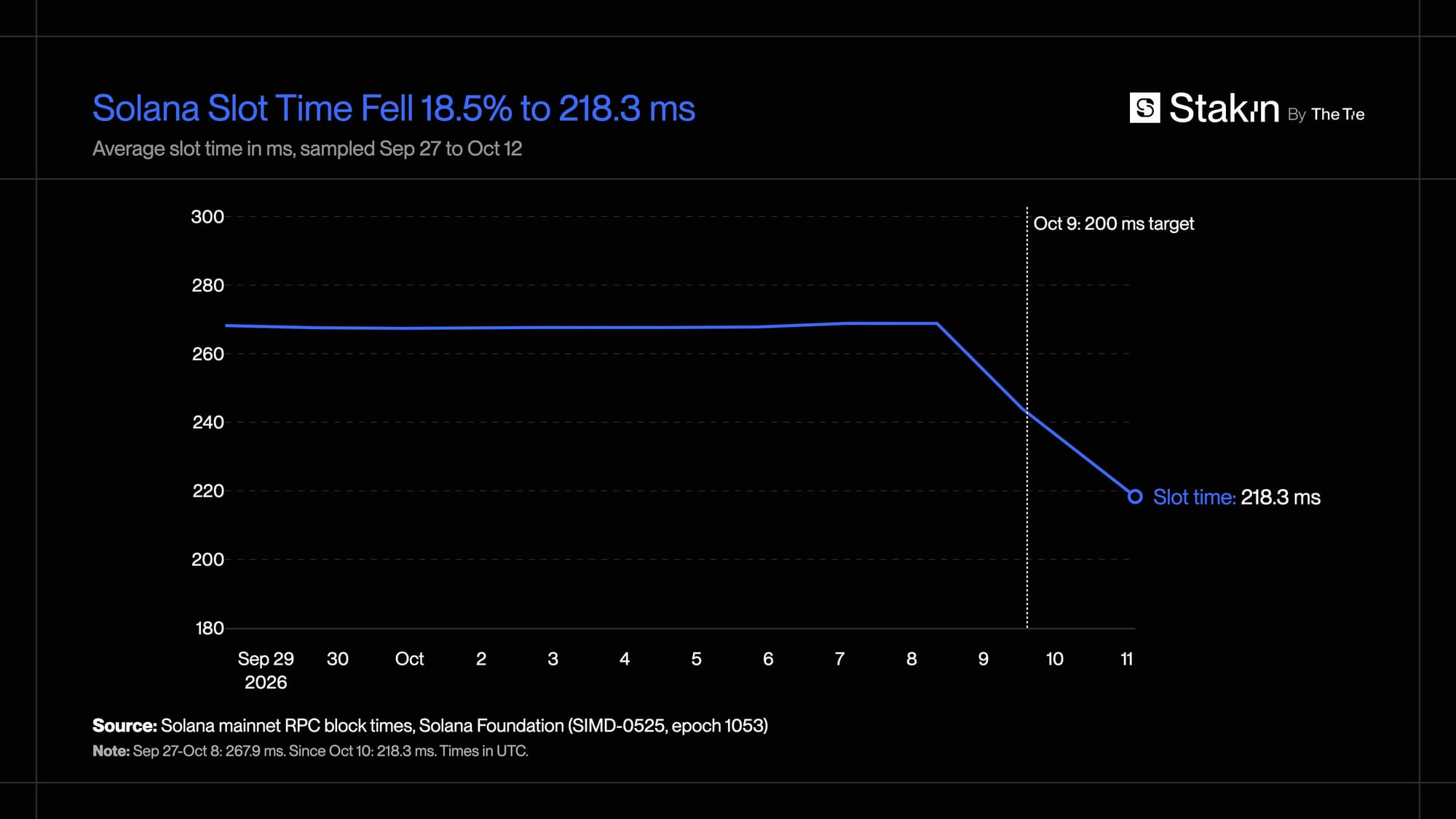
Measured slot times run a little above target. In the two weeks before the final cut, slots averaged 267.9 ms. In the days after it, they averaged 218.3 ms, 18.5% shorter.
Staking rewards are paid once per epoch, and an epoch is still 432,000 slots. At the current average slot time, an epoch now lasts about 26 hours, down from about two days before SIMD-0525 began.
Slot time is how often a block is produced, while finality, the part Alpenglow changes, is how long until a block can’t be reversed.
What does this mean for you?
If you stake with Stakin by The Tie, you don’t need to do anything. Our team handles the client upgrades and the migration itself. Shorter epochs also mean your rewards now arrive more often, and new stake starts earning sooner.
Your SOL stays where it is. There is nothing to migrate, claim or upgrade. Anyone asking you to move or update your SOL for Alpenglow is running a scam.
For validators
Alpenglow is a software upgrade. Validators need to run a client version that supports it before the switch, fund their vote account for the Validator Admission Ticket, and follow Anza’s announcements for the final timing.
For institutions and builders
A transaction that is final in about 150 ms can settle almost instantly, compared with the one to three business days of traditional settlement. Apps can also show users a final result without making them wait or retry.
Looking ahead
Alpenglow is the start of a faster Solana, not the end. Rotor and quicker handovers between validators are next on Anza’s roadmap. Our Solana validator is ready for the October 21 switch, and we’ll keep you updated as each step goes live.
DISCLAIMER: This is not financial advice. Staking and cryptocurrency investment involve a certain degree of risk, and there is always the possibility of loss, including the loss of all staked digital assets. Additionally, delegators are at risk of slashing in case of security or liveness faults on some PoS protocols. We advise you to DYOR before choosing a validator.